Verifiable Docking: Repairing Only What Needs to Move
A docking pose can be almost right and still clash with the protein. Can the clash itself tell us what to repair?
Introduction
A docking model can get a molecule almost right and still put one atom where a protein atom already lives. The usual fix is force-field relaxation: let the molecule settle. We wanted to give it a smaller job.
Can a failed check tell us which parts of the molecule need to move? A clash comes with a clue: the atoms that are in the way. We want to use that clue to keep the useful parts of a pose while giving the troublesome regions enough freedom to move.
The turning point was a control that repaired a clash it was supposed to leave alone. We had been choosing which atoms could move. We also needed to check whether the others actually stayed put.
On a fresh PoseX holdout, multi-component repair matched ordinary relaxation’s observed top-5 joint success with less displacement. Minimization was 3.14× faster by the ratio of medians; recorded repair wall time improved by 1.08×. Choosing what moves helped, but most of the speedup disappeared outside the minimizer.
Docking, in one picture
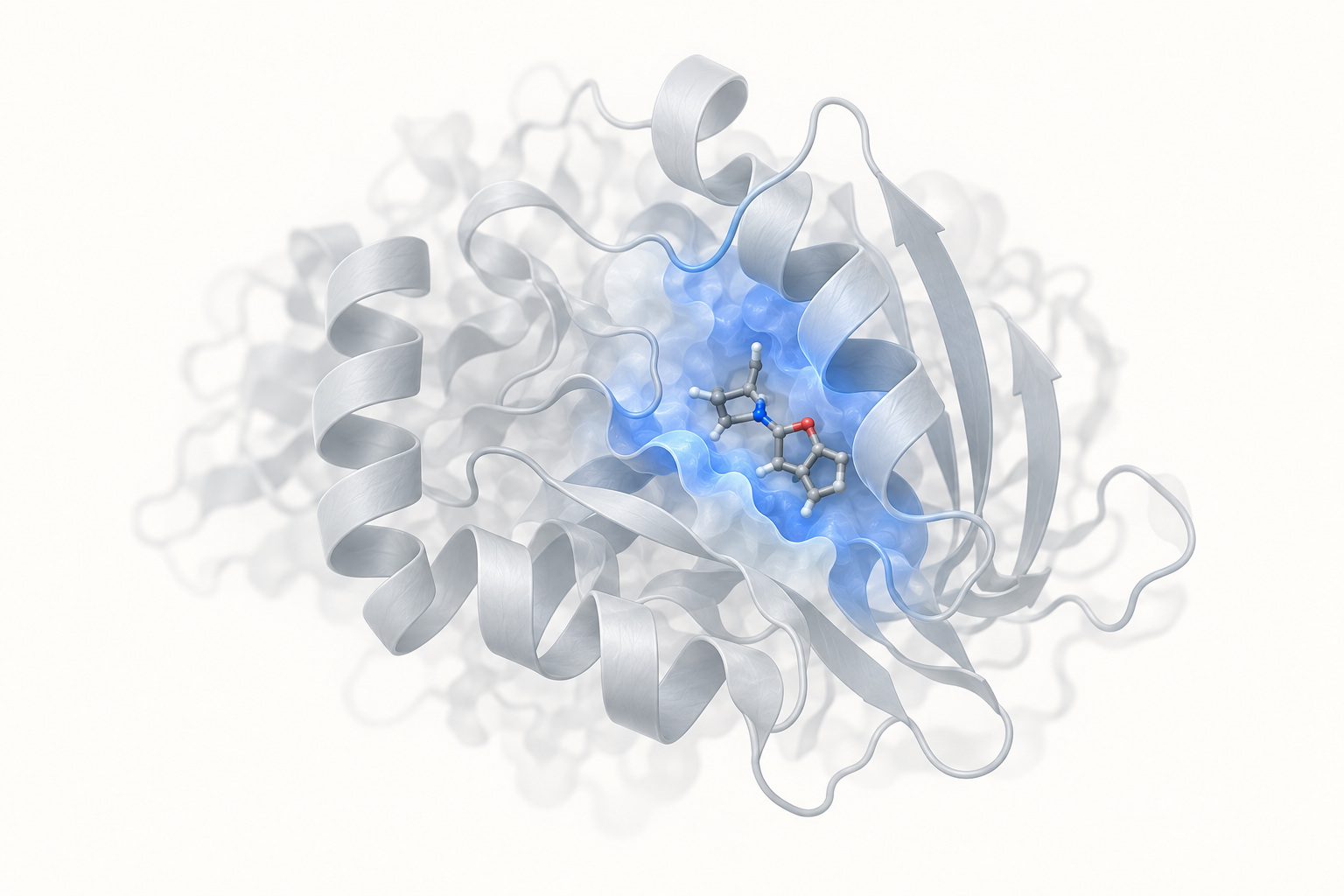
A ligand is a molecule that binds to a larger molecule; here, it is a small molecule binding to a protein. Docking asks for its bound pose: position, orientation, and internal conformation. Those choices are coupled. Rotating a bond can clear one clash and create another.

Different methods get to that pose differently. The distinction matters here because our intervention happens after a pose has been predicted.
| Approach | Examples | Main idea |
|---|---|---|
| Search and score | AutoDock Vina [1]; GNINA [2] | Search candidate conformations; GNINA adds learned CNN scoring. |
| Learn the geometry | EquiBind [3]; TANKBind [4] | Predict binding geometry with equivariant or distance-based models. |
| Generate poses | DiffDock [5] | Use diffusion over translation, rotation, and torsion. |
Our repair experiments start from DiffDock predictions. We evaluate accuracy against a reference and physical plausibility with the full PoseBusters suite [6], whose checks use the RDKit cheminformatics toolkit [7].
| Predicted pose | Fails validity | Passes validity |
|---|---|---|
| Near-native | Repair opportunity | Joint success |
| Far from reference | Neither criterion met | Plausible, but inaccurate |
We count top-5 joint success when at least one of the top five poses is both near-native and valid.
A strong baseline
The obvious fix set a high bar. On the public PoseX benchmark [8], ordinary relaxation made 410 of 433 initially near-native but invalid poses valid—about 95%.
A fresh DiffDock run told the same story: ordinary relaxation raised top-5 joint success from 41 to 77 of 200 cases. The baseline had already done most of the rescue work. We wanted a different win: keep that docking utility while moving less of the molecule.
Choosing what moves
A clash report comes with coordinates. We call the clash a witness: a concrete example of where the pose violates a physical constraint. It points to a repair scope, the set of atoms allowed to move. Choose the scope, relax it, and check again.

First, we tried candidate scopes and selected the best result with hindsight—an oracle. Global relaxation in OpenMM supplied the baseline [9]. Very small scopes missed repairs. Expanding through neighboring constraints helped: a factor graph connects atoms to the constraints that couple their motion [10].
| Scope | Valid poses | What it tells us |
|---|---|---|
| Global relaxation | 94/106 | A strong reference |
| Strict-local oracle | 84/106 | Too little freedom |
| Oracle, smaller scopes first | 95/106 | About 27% of non-hydrogen atoms movable, at the median |
Many of these repairs could leave most of the ligand fixed. The next step was to choose a scope from the clash itself. The resulting procedure is short: try local repair, then fall back to ordinary relaxation when the check fails.
# Choose what moves, then check the result.
def repair(pose, protein):
    witnesses = find_clashes(pose, protein)
    scope = choose_components(pose, witnesses)
    local = relax(pose, protein, movable=scope)
    assert unchanged_outside(pose, local, scope)

    if verifier_passes(local, protein):
        candidate = local
    else:
        candidate = ordinary_relaxation(pose, protein)
    return candidate
The local check decides whether to take the fallback; the full PoseBusters suite evaluates the final output. We reserve reference-pose accuracy for evaluation.
Our control worked. That should have been impossible.
The guided repair made 160 of 166 poses valid. So did the random control. We were trying to show that the clash location mattered; the minimizer seemed perfectly happy without it.
Then we looked at the atoms that were supposed to stay put. Even when the control scope excluded the clashing atom, that atom was still moving.
In the random control, clashing atoms outside the chosen repair scope had a median displacement of about 0.36 Å under soft restraints. With hard freezing, the maximum displacement of any frozen non-hydrogen atom was 0 Å.
The boundary was negotiable. A soft restraint puts a price on movement. If clearing a clash saves enough energy, the minimizer pays the price.
Let x^0 be the starting coordinates and F the atoms outside the movable set, including the protein. A soft restraint adds a quadratic tether of strength \kappa to the system’s potential, E_0:
Hard freezing closes the loophole. Staying put becomes a condition of the optimization:
In OpenMM, zero-mass particles stay fixed during minimization. We use them to enforce the boundary; each selected non-hydrogen atom brings its attached hydrogens into the movable set.
With that boundary enforced, guided repair pulled ahead of the random and swapped controls.

The control had found a loophole in our experiment. Closing it made the location signal visible.
Covering several clashes
A ligand can clash in more than one place. With a single anchor, about half the poses in a reserved test set needed ordinary relaxation as a fallback, making the full procedure slower. We gave the next operator several anchors.
The multi-component operator groups connected clash atoms, chooses an anchor for each group, and unions their local neighborhoods. After finding a passing pose x^1, it can shorten the edit by moving back toward the input:
A short bisection search keeps a passing step closer to the input. We then tested this operator on 200 fresh PoseX pairs, including 127 poses in the repair cohort.

| Method | Top-5 joint ↑cases | Displacement ↓Å · median | Speedup ↑ | |
|---|---|---|---|---|
| Minimization | Recorded wall | |||
| Ordinary relaxationbaseline | 65/200 | 0.301 | 1.00× | 1.00× |
| Multi-component cascadelocal repair + fallback | 65/200 | 0.193 | 3.14× | 1.08× |
Bold marks observed improvements over the baseline. Displacement is RMS motion over ligand heavy atoms, then median across repair poses. Speedups are relative to ordinary relaxation and include fallback: a ratio of median minimization times, and a ratio of summed recorded wall times.
Most poses now took the local route. The cascade matched ordinary relaxation’s observed joint count while moving the ligand less. The operator met the targets set before the experiment, including comparisons with matched control scopes.
The full cost of repair
Minimization is only one item on the bill. Its reported speedup was 3.14×; recorded repair wall time improved by 1.08×. Both timings include the ordinary fallback. Detection and verification cost time too.
Amdahl’s argument [11] makes the next experiment clear: profile the whole repair. Faster local motion is useful; the next gain has to survive the surrounding work.
Teaching the model where to look
We also trained a model that passes information between atoms and their constraints to rank a fixed menu of repair scopes. The development test covered 106 poses from 43 protein families, with each pose evaluated by a model trained on other families.
We counted a small repair as a success when the first accepted candidate, among at most three tries, passed the study’s 20 structure and plausibility checks while allowing at most 30% of non-hydrogen atoms to move.
Without the clash location, the success rate was 2.8%. With it, 23.6%. The model could learn to follow the clue.
What still needs to travel
The next test is on unfamiliar binding pockets. DockGen tests novel binding domains [12]; PoseBench evaluates broader docking settings [13]. Our external studies also used Astex [14] and CASP15 ligand tasks [15].
We would keep the repair rule fixed and change the proteins: new families, new pockets, the same local decisions. Alongside that test, we need to time detection, selection, verification, and fallback with the minimizer. That is where we would look for the next speedup.
The control taught us to take fixed literally. Once we did, the clash became a useful instruction: start moving here.
Limitations
The multi-component result comes from one fresh PoseX holdout, with previously used pairs and ligand groups excluded. Transfer to new protein families remains unconfirmed. Broader external experiments encountered lower docking success, accepted poses that failed the final checks, too few test cases, or no clear advantage over control scopes.
The oracle and hard-freeze experiments serve different purposes. Table 1 uses hindsight on 106 previously examined poses selected by reference-pose accuracy; broader testing did not establish that sparse repair preserves ordinary relaxation’s performance. Hard freezing was a follow-up diagnostic after the soft-restraint test failed its planned control comparison, and its top-5 joint success remained below ordinary relaxation.
Physical validity assesses molecular geometry and plausibility, rather than establishing the true bound pose. The learned selector uses a separate 20-check protocol, distinct from the earlier full PoseBusters endpoint. Its development results missed the size and coverage targets in Table 3; reference-pose accuracy and a separate confirmation set remain unevaluated.
| Requirement | Observed |
|---|---|
| Keep movable regions small | 50.6% movable atoms at the median among accepted repairs; target ≤ 30% |
| Approach the best available scopes | 58.5% passing vs. 66.0% with hindsight; allowed gap: 5 percentage points |
| Preserve docking accuracy on new data | Not yet evaluated |
Recorded wall time covers the repair call and initial clash detection, excluding docking, preparation, and surrounding scope construction. The minimization speedup compares medians, while the wall-time speedup compares sums. These ratios alone cannot identify how much time each stage takes.
The optimization equations describe objectives. The control runs capped minimization at 100 iterations, and backtracking searches along one interpolation path. Neither procedure guarantees a global minimum or a globally smallest repair.
References
- Trott & Olson. AutoDock Vina: improving the speed and accuracy of docking with a new scoring function, efficient optimization, and multithreading. Journal of Computational Chemistry, 2010.
- McNutt et al. GNINA 1.0: molecular docking with deep learning. Journal of Cheminformatics, 2021.
- Stärk et al. EquiBind: Geometric Deep Learning for Drug Binding Structure Prediction. ICML, 2022.
- Lu et al. TANKBind: Trigonometry-Aware Neural NetworKs for Drug-Protein Binding Structure Prediction. NeurIPS, 2022.
- Corso et al. DiffDock: Diffusion Steps, Twists, and Turns for Molecular Docking. ICLR, 2023.
- Buttenschoen, Morris & Deane. PoseBusters: AI-based docking methods fail to generate physically valid poses or generalise to novel sequences. Chemical Science, 2024.
- RDKit contributors. RDKit: Open-source cheminformatics. Project documentation.
- Jiang et al. PoseX: AI Defeats Physics Approaches on Protein-Ligand Cross Docking. arXiv, 2025; revised 2026.
- Eastman et al. OpenMM 8: Molecular Dynamics Simulation with Machine Learning Potentials. Journal of Physical Chemistry B, 2024. Simulation toolkit background.
- Kschischang, Frey & Loeliger. Factor graphs and the sum-product algorithm. IEEE Transactions on Information Theory, 2001. Background on factor-graph representations.
- Amdahl. Validity of the single processor approach to achieving large scale computing capabilities. AFIPS Spring Joint Computer Conference, 1967.
- Corso et al. Deep Confident Steps to New Pockets: Strategies for Docking Generalization. ICLR, 2024.
- Morehead et al. Assessing the potential of deep learning for protein-ligand docking. PoseBench; arXiv, 2024, revised 2026.
- Hartshorn et al. Diverse, high-quality test set for the validation of protein-ligand docking performance. Journal of Medicinal Chemistry, 2007.
- Robin et al. Assessment of protein-ligand complexes in CASP15. Proteins, 2023.
Citation
@misc{yoshihara2026verifiabledocking,
  title={Verifiable Docking: Repairing Only What Needs to Move},
  author={Kirato Yoshihara},
  year={2026},
  url={https://kiratoyoshihara.github.io/essays/verifiable-docking.html}
}